Wednesday, October 19, 2011

At Home with Wyatt and Zoe

If a picture is worth a thousand words, then a video clip must be worth, what?  A million?  Two million?

I've been asked to post more of these by a few of you.  I am also exhausting myself, so to keep an easier pace (as we are just over halfway through this challenge), I'm going to let them tell you how they are doing this week.

Both are chewing constantly... those teeth are coming in but extremely s-l-o-w-l-y.  They are grumpy at random and everything is chew, chew, chew!  Wyatt likes one particular red chewy;  it's different sections have different textures and by chewing on all of them he is developing his facial, mouth and tongue muscles.  Zoe... well, she is just a ham (who always loses her soother).  I tried to get Wyatt doing a few things, but Zoe had a "tookie" crisis and tried to climb up on my knee.  Yes, that is black nail polish.


Round two.  Tried to get more of Wyatt, but Zoe dropped by for a visit.


Finally, Zoe Attacks!  (And you get to be nommed by her.)  Enjoy!
 

Tuesday, October 18, 2011

A Brief History of Down Syndrome, Part 2: Before John Langdon Down


As current data suggests that DS occurs in 1 out of every 700 or so births, you would think someone would have noticed it before 1858 (perhaps in every culture since the dawn of time).  That would be correct.  As Down syndrome has been stigmatized and de-stigmatized at several points in human history, the physical evidence is few and far between.  However, it is still there.

From Prehistory

There are several instances of material evidence from prehistory that experts believe depict Down syndrome.  Clay tablets from Babylon dating back to 4000 BC record congenital 'malformations'.  Included are 62 human 'malformations' (and associated prophetic relations).  There is evidence from the Paleolithic era (18,000 years ago) which may depict Down syndrome or a related condition.  Taurodontism has been found in two teeth of this era, which is often associated with chromosomal disorders such as trisomy 21. (Savona-Ventura, ?).  A skull from a monastery at Breedon-on-the-hill in North West Leicestershire in England dates to approximately 700-900 AD and is alleged to have numerous features typically seen in individuals with Down syndrome.  Among those listed are an overall reduced size, microcephaly, a smaller skull cap, small maxilla, smaller skull length, thin cranial vault bones, smaller face and cheek bones, brachycephaly,  thick mandible, mandibular prognathism and irregular tooth development. (Starbuck, 2011).
Photobucket
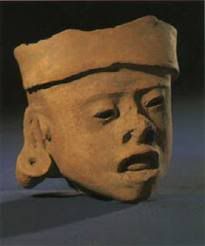
Tolteca terracotta figurine
This terracotta figurine from Mexico dates to the Tolteca culture (approximately 500 AD) and depicts facial features that suggest Down syndrome:  small, up-slanting eyes, a small face, noticeable tongue, a weak nasal bridge and an open mouth. 
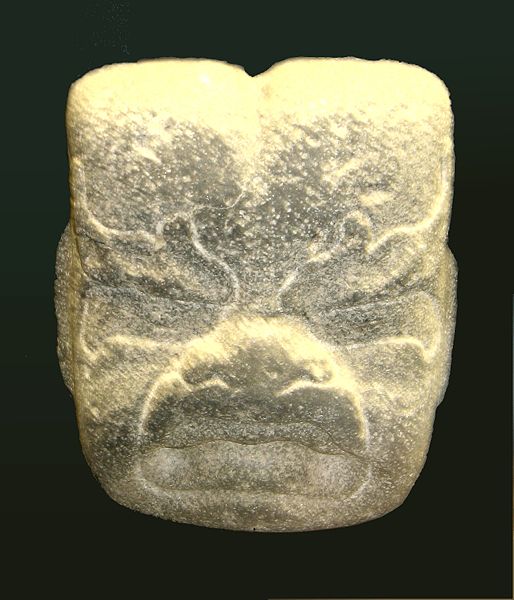
Olmec Were-Jaguar

Olmec mother holding jaguar child
One of the more disputed theories lies with the Olmec culture (also of Mexico) which existed from roughly 1500 BC to 300 AD.  The surviving art of this culture often depict jaguars mating with older women of the tribe to produce 'jaguar-babies' or 'were-jaguars'.  It has been put forth by numerous sources that these 'jaguar babies' probably had Down syndrome based on the fact that they were a) born to older women, b) were depicted with sharp teeth (possibly ectodermal dysplasia), c) had small, slanted eyes, d) had flattened noses, e) were often rounder or more overweight than other representations of children (hypotonia and hypothyroidism) f) were often depicted in unusually flexible positions (suggesting hypermobility), g) when depicted as infants, were depicted limp (hypotonia again)  and h)  had cleft heads (enlarged metopic suture). Again, the physical evidence is moderate at best making this a widely disputed argument in the anthropological world. 

The Tumaco-La Tolita culture of Columbia and Ecuador (600 BC to 350 AD) is known for depicting a variety of diseases and ailments in their work.  One figurine in particular is suggestive of Down syndrome (Bernal, Brecino, 2006 and Starbuck, 2011) as it depicts a short, obese person with small, up slanted eyes, an open mouth, a small nose with depressed bridge, a small face relative to the rest of the head, a protruding jaw and thickened fingers.

Historical Evidence Potentially Depicting Down syndrome

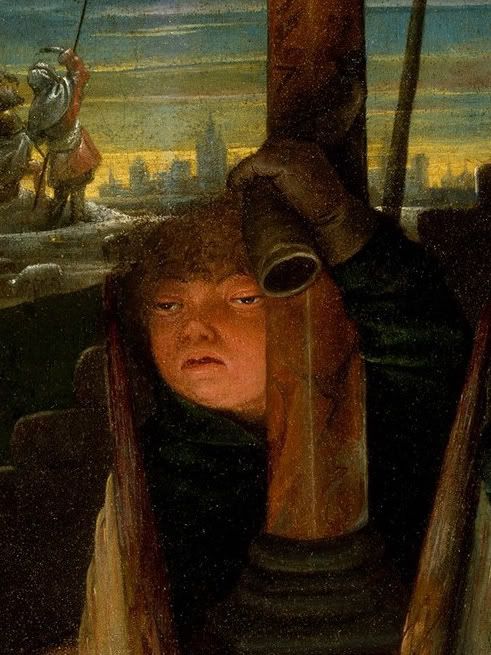
One of the oldest is a painting from roughly 1505 referred to as "Ecce-homo-scene".  It has been put forth that the child depicted in this painting has the characteristics of Down syndrome.  The eyes are small and slightly up slanted, the neck is broad, the ears small and low set, the face small compared to the rest of the head, there is a weak nasal bridge, the mouth is open and there is an overall stocky appearance.  It could be inferred from this painting that the child is a type of street performer;  in fact there is a monkey on a leash which is grooming the child's hair. Sadly, this last aspect would fit with the times. (Starbuck, 2001)

Virgin and Child with Saints Jerome
and Louis of Toulouse
 The next are a series of religious paintings that have been attributed to Andrea Mantegna (1431-1536).  The first, Virgin and Child with Saints Jerome and Louis of Toulouse (approx 1455 AD) depicts a child with up slanted small, widely spaced eyes, an open mouth with a protruding tongue, short digits with an in-curving 5th finger and a weak nasal bridge with a "button" nose. Also notable is the hypotonic or relaxed facial expression.

Madonna and Child
Virgin and Child
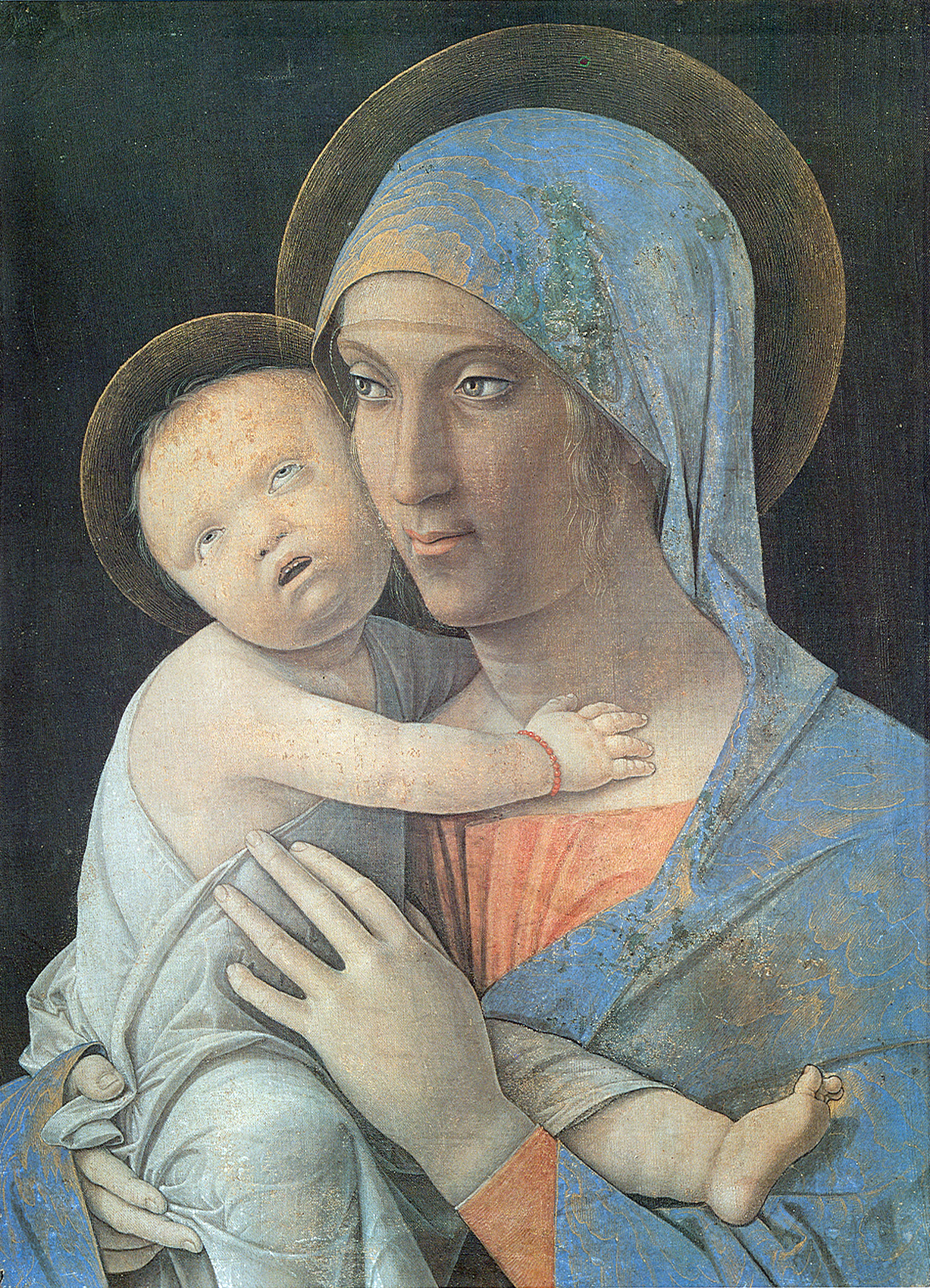
Around 1460, Mantegna created Madonna and Child which has also been suggested to exhibit characteristics of Down syndrome: epicanthal folds, small narrow eyes, an open mouth, hypotonic expression, flattened nasal bridge and button nose.

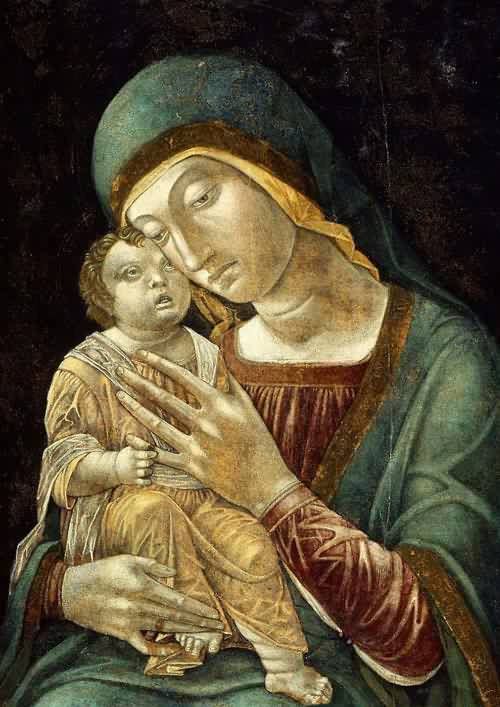
Also from (approx.) 1460 AD, is a painting entitled Virgin and Child which experts believe to also exhibit characteristics of Down syndrome.  Among those listed are:  epicanthic folds, oblique eyes, open mouth, protruding tongue, in-curving 5th finger, widely spaced first and second toe, a smaller head, a short, broad neck and hypotonic facial expression. 

It has been suggested that the reason for several of his paintings having children with Down syndrome features (while others notably do not) is due to the claim that one of Mantegna's 14 children had Down syndrome and one of his patrons, the Gonzanga family, also had a child with Down syndrome (which reportedly died at four years of age). (Starbuck, 2011)
The Adoration of the Christ Child

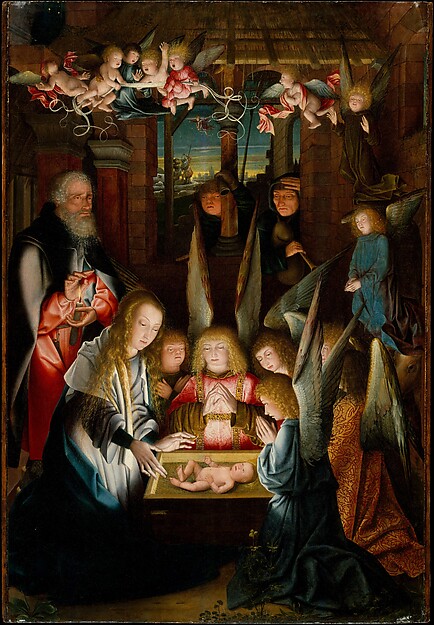
One of the most famous examples is found in the Flemish painting The Adoration of the Christ Child, created around 1515 by a follower of Jan Joest of Kalkar.  There are two individuals in this painting that have strikingly different facial features than the others and it has been argued that they depict people with Down syndrome.
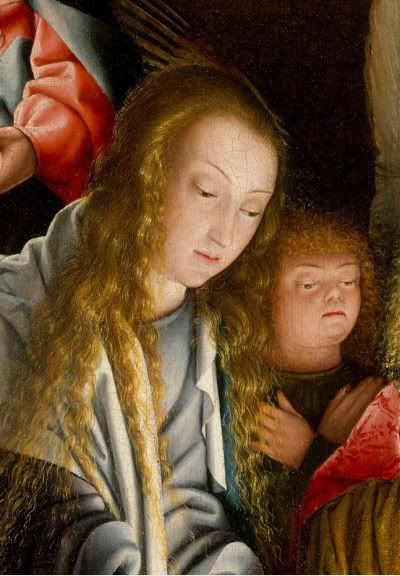
Detail of The Adoration of the Christ Child

The first figure is an angel to the right of the Madonna.  Unlike the Madonna, the angel figure displays a flatter than normal face, up-slanting narrow eyes, epicanthic folds, flattened nasal bridge, upturned button nose, a downturned mouth and shorter than normal digits.
Second detail of The Adoration of the
Christ Child

The second figure is a shepherd boy located in the background.  It has very similar features to the previous angel (ie: flatter face, up-slanting narrow eyes, epicanthic folds, a flat nasal bridge, a button nose and a downward turned mouth).  This figure however, also has widely spaced eyes and a hypotonic expression on the face.  It is to be noted that there is a second "daytime" version of this painting where these characters are more typical looking. (Starbuck, 2001)

It is well known that those with disabilities, both learning and otherwise have been scorned, ridiculed and even regarded as evil throughout the ages.  Even Aristotle stated in his Politics: "...as to the exposure and rearing of children, let there be a law that no deformed child shall live."  This has persisted right up to modern day and beyond John Langdon Down.  With this artistic evidence, it makes one wonder if not everyone felt this way.  Aside from the were-jaguars, it is interesting that there are two separate versions of the Adoration of the Christ child and that the infant Jesus was depicted in such a manner.  I would like to think that this would suggest that small pockets of free thinkers, small groups of people who were touched by Down syndrome saw beauty, not an abomination.  I would like to think that there have been people throughout history that did not fear and despise those that were different, but rather saw them as something special.  So much so that they would depict their 'Savior' with those same characteristics.

------------
Bernal, J. E., and I. Briceno, 2006 Genetic and other diseases in the pottery of Tumaco-La Tolita culture in Colombia-Ecuador, Clinical Genetics, 2006

Savona-Ventura, Charles ( ) Historical Perspective Congenital Malformations: a historical perspective in a Mediterranean community

Starbuck, JM, On the Antiquity of Trisomy 21:  Moving Towards a Quantitative Diagnosis of Down Syndrome in Historic Material Culture, Journal of Contemporary Anthropology, October 2011
------------

A Brief History of Down syndrome: Part 1, Part 2, Part 3, Part 4, Part 5, Part 6, Part 7

Monday, October 17, 2011

Hearing Complications with Down Syndrome

PhotobucketNot only does hearing allow us to experience the sounds around us, but it plays a major role in the development of speech. Children with Down syndrome can have a variety of hearing issues, both congenital and acquired, which if not treated can lead to greater problems.

Congenital disorders of the ear generally involve a sensorineural issue (whereby the sensory information is not transmitted or received by the auditory nerve properly). Often this involves the higher tones and is therefore not discovered until later on (as the child would continue to hear many of the sounds around them) and would therefore impact on their development (especially with speech). Routine screening allows for the discovery of congenital ear disorders. Down syndrome may affect any or all of the structures in the middle and inner ear.

Acquired hearing disorders can be divided into two categories: conductive hearing loss and sensorineural hearing loss. These can occur separately or together; many children with Down syndrome have a mixture of both.

A build up of cerumen (ear wax) can easily interfere with the functioning of the eardrum. If mobility of the eardrum is decreased, the sounds transmitted to the middle ear will be decreased as well. This is easily treated by a variety of measures including drops and suction removal by a qualified professional.

Those with Down syndrome can be more susceptible to more infections than the general population and as a result have a higher incidence of ear infections. Over time and especially if left untreated, these infections can cause damage. Fluid buildup in the middle ear, a ruptured tympanic membrane (eardrum) and difficulties with the ossicles can all result from infection.

As well, a condition commonly referred to as "glue ear" can develop. Sticky mucus can accumulate in the middle ear which can literally encase the ossicles and prevent them from vibrating (and therefore, transmitting sound). People with DS can produce more or stickier "glue" which frequently becomes infected as it does not drain away. Further hindering drainage is overall smaller Eustachian tubes in those with Down syndrome as well as the tendency for these tubes to be sharply curved.

With both of these conditions, antibiotics are most often prescribed. If the fluid or glue buildup is persistent, the child may have to undergo a tympanostomy and have "tubes" or grommets placed in the eardrum to allow the fluid to drain away.

As with any potential problem, early intervention is the key. Have your child assessed early by a trained audiologist and your medical team to prevent and minimize the chances of long term hearing loss.

"Anatomy of the Human Ear" shared with permission by Perception Space-The Final Frontier, A PLoS Biology Vol. 3, No. 4, e137 doi:10.1371/journal.pbio.0030137. Creative Commons.

Sunday, October 16, 2011

Day of Rest?

Ahh Sunday.  So we meet again.

Sundays start out with that promise of sacred time.  I'm not talking in the religious sense; it always starts out feeling like stolen time for you and your kids.  You may get to sleep in a bit.  Breakfast will be involved.  Coffee will be savoured.  Fun things will be planned for the afternoon. These things rarely come to fruition however as the illusion of Sunday morning is usually shattered by 10:30.  By crying.  Sometimes it's actually the kids doing that. 

I'm often asked questions like "how do you manage" or "where do you find the time?".  Other than my usual stunned look, I often answer with "I don't know" or "when I figure it out, I'll tell you?".  The truth is, time is pretty finite in the waking hours.  When I am off (and not actually sleeping after my night shifts), I have a limited amount of time to get everything [read: anything] done.  Period.

Our 'day of rest' usually goes something like this:

Assuming one of us isn't already up by 6, Quinn gets up around 7-7:30 ish.  There is usually quiet cereal and TV.  The babies wake up somewhere around 8:30 or nine and the feeding commences.  Two babies get their bums changed, two babies get dressed and brought downstairs for some floor time (they spend a lot of time on the floor to build their muscles).  There is a "Medela moment".  We are now somewhere around 10:00 or 11:00.

Lunch is discussed and then abandoned as a topic as we are inevitably interrupted by one of/all of the kids or in a forgetful stupor one of us decides to wander away to try and complete at least one simple task (ie, throw in a load of laundry, unload and reload the dishwasher, fold a load of laundry, what have you).  We usually opt for brunch at this point as quiet cereal and TV were some time ago.  We haven't eaten yet (or Sean has eaten lightly) and Quinn is now ravenous and screechy.  Sean either makes something lovely or "quick and dirty".  I wolf my food in between separating/rescuing/soothing/cleaning/redirecting at least one baby.  Quinn has resorted to making "crafts" out of everything in sight.  Small bits of paper are removed from Zoe's hand/gaze/throat.  Wyatt is either asleep on his tummy or quietly watching everything.  They usually start shouting around now and it is time to feed them again.  Which we do, including real food.  Babies are changed again as we have to hose them both and the kitchen down.  There is another Medela moment.

Then it is nap time.

Naps are a real bone of contention around here.  I'm all for them.  I am pro-nap.  I would rather we all have a little siesta in the afternoon and go to bed a little bit later then have the alternative which involves a lot of screaming, crying and general carry-on.  Quinn napped right up until last year when his daycare provider "helpfully broke him of the habit" [translation:  felt it was stupid and since she drove around all afternoon ferrying various children hither and yon, it was an easier for her].  If anyone needs a nap around here in the afternoon (other than me, of course) it is him.  If he doesn't sleep, he is an absolute terror by suppertime and most of that time will be spent on the stairs in "time out".  A nap for Wyatt and Zoe will be attempted.  They both may nap for a few moments initially, but that will end.  Especially if Quinn is actually asleep as we can only have two out of the three napping at the same time.  One will wake up, (usually Zoe) and be screechy.  Assuming she won't go back to sleep after her soother is found and replaced and hasn't woken up her twin, she'll be brought down to the living room to play.  Where she will until she passes out an hour later, at which time Wyatt wakes up hollering.  If Wyatt wakes up first I can bring him down and plunk him in the swing and he will sleep, but this only happens if Quinn is awake.  Confused yet?  All of this boils down to NO NAP FOR MOMMY.  None.  Dee-nied.

Now it is somewhere around 3 or 3:30.  My eyes are closing now whether I like them to or not.  I hit the Tassimo.  It is short lived as I seem to be able to metabolize caffeine very fast.  I am even more tired 45 mins later. Sean may stumble off to have a nap or have one downstairs as he is entertaining Quinn.  Babies are changed post-nap and put on the floor again.  I may scatter toys around and let Indiana Zoe discover them or lay on the floor and play with them.  One of them will have a "problem" (fussy) so as one parent goes off to do whatever project they had to do for the day, the other entertains kids (usually me). Now there is talk of dinner.  Sean goes off to make that/set up the baby food as I start feeding the babies.  More highchair time.  More hosing.  More diaper changes.  Another Medela moment. 

Dinner is prepared and scarfed down in record time as there is usually at least one member of the family crying or having an issue.  Dishes are attempted, but usually abandoned in the sink.  Issues are addressed and babies are played with as Quinn putters around us, interacting with some or all of us.  It is somehow around 8 now (I am surprised each and every time).  Babies are taken upstairs and if it is a bath night, that ritual is begun.  One of us (we alternate when I am home) is in charge of undressing, un-diapering, towel wrapping, towel unwrapping, drying off, diapering and jam-ifying.  The other is in charge of bathing.  We started out each washing a baby with two tubs but we found that an assembly line type operation works better.  One of us nips off to make up their bedtime "top up bottle" (of EBM) and then its more feeding.  One of us each gives a bottle (we alternate), snuggles and then they are put to bed.  It is now somewhere between 8:30 and 9:30.  Quinn's needs are now met (he bathes opposite to the babies... it was a compromise that makes our evenings not drag on forever) and he is put to bed, usually by Sean as I am having another Medela moment.

Depending on what Monday morning will bring, we either have a few moments to ourselves or one of us is doing laundry or escaping for some alone time.  Or collapsing in a heap in front of the TV.   If I'm working the next day, I'm off to bed.  G'bye Sunday, we hardly knew ye.

So, to answer the question "How do you find time to do it all", the answer really is "I don't".  I also don't even try any more.  "Fires" are put out and we do the bare minimum.  Larger cleaning projects are tackled just like that:  as a large project that takes up a block of time.  Despite all the multitasking and my ability to do just about anything while holding a baby (including write this) , it doesn't get done.  Oh well.  It used to drive me nuts, but I've come to terms with it.  It will all get done... eventually.

Our "day of rest", like any other parents, is a joke.  We have to do two loads of baby laundry a day to keep up with them.  I still wouldn't trade it for the world. Quinn, when not being "Dynamo:  The Kid Dramatic" is really freaking funny and his younger siblings are completely edibly adorable.  I know I have said this before, but Sean and I are incredibly lucky to have each other.  It works.  It gets done.  I don't know how, but it does.  Much like this blog entry, which has taken a ridiculous amount of time to write (and is probably poorly edited).

Happy Sunday.  Enjoy your day of "rest", whatever form it may take.

Added to the 'Define Normal' Blog Hop! Find out more @ Just Bring the Chocolate
Related Posts Plugin for WordPress, Blogger...